
Why Your Brain Freezes in Conversation (and 3 Ways to Solve It Fast)
You’ve been preparing for this moment. You know the words. You’ve practiced the phrases. You understand the grammar. You’re ready.
Then someone actually speaks to you in your target language.
And your mind goes completely blank.
Every word you’ve ever learned vanishes. Your mouth opens but nothing comes out. You stand there, frozen, while precious seconds tick by and the other person’s smile starts to fade into awkward concern.
This is “conversation freeze”—and it’s one of the most frustrating, confidence-destroying experiences in language learning.
The Blank Mind Phenomenon: What’s Actually Happening
First, let me tell you something important: This isn’t a language problem. It’s a nervous system problem.
When you freeze in conversation, it’s not because you don’t know the words. It’s because your brain has entered a mild fight-or-flight response. Your amygdala—the part of your brain responsible for detecting threats—has decided that this conversation is dangerous.
Sounds dramatic, right? But to your primitive brain, social judgment is a threat. Being laughed at, rejected, or humiliated by the tribe used to mean death. So when you’re about to speak in a foreign language and risk sounding stupid, your nervous system treats it like you’re about to face a predator.
The result? Your prefrontal cortex (the part that does complex thinking and retrieves vocabulary) essentially goes offline. Blood flow redirects to your muscles. Your working memory capacity shrinks. And all those words you “knew” become completely inaccessible.
Why Self-Study Makes It Worse
Here’s the cruel irony: the more time you spend studying alone, the worse the freeze becomes.
When you practice by yourself—with apps, textbooks, or even speaking to your mirror—you’re training your brain in a zero-stakes environment. There’s no social pressure. No time limit. No one waiting for your response. No fear of judgment.
Then you step into a real conversation, and your brain encounters a completely different context. It’s like training for a piano recital by playing alone in your bedroom, then being shocked when you can’t perform in front of an audience.
You haven’t trained for the actual conditions you’ll face. And your brain knows it.
The Three Elements Missing From Your Practice
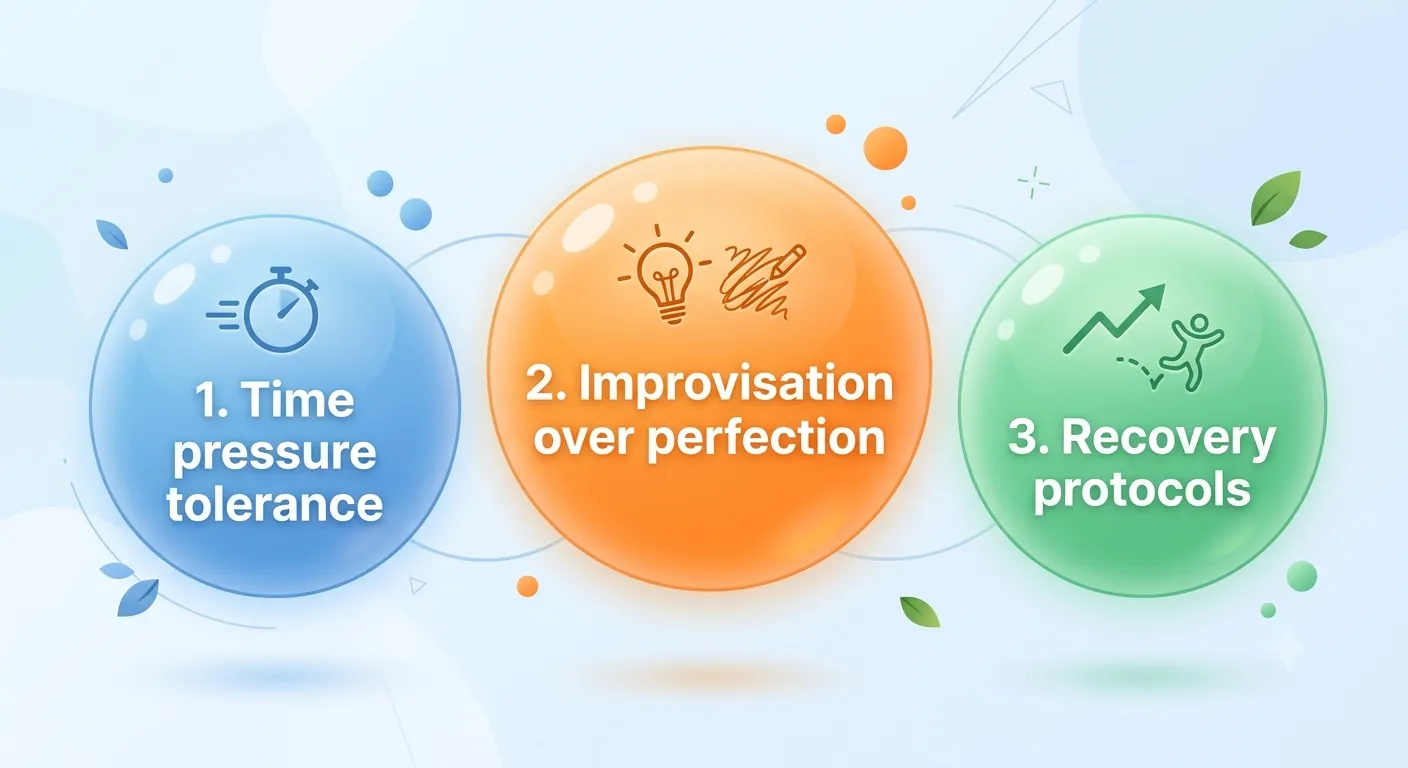
The freeze happens because you’re missing three critical components that only live practice with another person can provide:
1. Time pressure tolerance: Real conversations happen in real-time. You have maybe 2-3 seconds to respond before the silence becomes awkward. Apps and solo practice never train you to access language under this kind of pressure. You need repeated exposure to the feeling of time pressure until your nervous system stops treating it as a threat.
2. Improvisation over perfection: When you study alone, you can edit yourself endlessly. You craft the perfect sentence before saying it out loud. But real conversation is messy, imperfect, and requires you to speak with 70% certainty instead of 100%. This is a skill—and it only develops through practice with a real human who forces you to respond before you feel “ready.”
3. Recovery protocols: The freeze isn’t the problem—it’s what you do after the freeze that matters. Do you know how to restart when your mind goes blank? Do you have “filler phrases” to buy yourself thinking time? Can you ask for a moment to gather your thoughts? These are tactical skills that no textbook teaches.
Why You Need a Professional to Break the Pattern
You cannot unfreeze yourself through more studying. You cannot think your way out of a nervous system response.
You need controlled exposure with a professional who understands the neuroscience of language anxiety.
Here’s what a skilled instructor does that you can’t do alone:
They create a psychologically safe space where the stakes feel lower while still providing real conversation practice. They know how to calibrate the difficulty—challenging enough to trigger mild stress (which builds tolerance) but not so much that you shut down completely.
They normalize the freeze. When it happens with a professional, they don’t judge you or act uncomfortable. They wait, give you strategies to restart, and help you see that pausing or stumbling doesn’t mean failure. This rewires your brain’s threat response over time.
They diagnose the root cause. Sometimes the freeze isn’t about anxiety at all—it’s a sign that your foundational vocabulary is too weak, your grammar automation isn’t developed enough, or you’re trying to translate in your head instead of thinking in the language. A professional can identify the real issue and address it specifically.
The Assessment You’re Avoiding (But Desperately Need)
Here’s a question most learners don’t want to answer: Do you actually know why you freeze?
Is it because:
- Your vocabulary recall is too slow?
- You’re translating word-by-word instead of thinking in concepts?
- You don’t have enough automated phrases to fall back on?
- Your listening comprehension creates a lag that compounds your response time?
- You’re genuinely experiencing performance anxiety that needs specific intervention strategies?
You can’t fix the freeze without knowing what’s causing it. And you can’t diagnose it accurately while you’re sitting alone with a textbook.
A proper assessment—conducted by someone who’s seen hundreds of learners struggle with this exact issue—reveals not just your language level, but your performance profile under pressure. It shows where your retrieval breaks down, what conditions trigger the freeze, and which specific interventions will work for your brain.
This isn’t fluffy advice. It’s data. And data is what separates learners who stay frozen for years from those who break through in months.
Your Way Forward
If you’re tired of freezing mid-conversation, if you’re exhausted from “knowing” the words but not being able to access them when it counts, if you’re ready to stop letting fear steal your progress—then it’s time to change your approach.
You need:
- Structured conversation practice with someone who won’t judge you when you freeze
- Progressive exposure that builds your tolerance to time pressure gradually
- A clear diagnosis of what’s actually blocking your retrieval (because it might not be what you think)
- Personalized recovery strategies that work for your specific freeze pattern
You can’t get this from an app. You can’t get it from YouTube videos. You need a professional who understands both language acquisition and performance psychology.
The first step is understanding your current baseline. Not how many words you know, but how you perform under real conversational pressure. Where exactly does the breakdown happen? What percentage of your knowledge is actually accessible when you need it?
Take Our Speaking Performance Assessment and discover exactly why your brain freezes, what conditions trigger it, and the specific training protocol that will help you access your language skills when they actually matter—in real conversations with real people.
Because you don’t have a vocabulary problem. You have a performance problem. And those require completely different solutions.
Stop studying harder. Start training smarter. The words are already in your brain. Let’s teach you how to find them when you need them most.